Nashville evictees file civil rights complaints

Photos by Alvine
By Mike Lacy
- Lived experience


“What’s going on with the kid?” I asked Carrie* as she sat in her tent in the woods between a shopping center and a suburb in Hermitage. She had recently given birth.
“I put it up for adoption,” she said.
“Do you think you would have done that if you had a place?”
“No.”
Two years ago, Metro Nashville’s Office of Homeless Services promised Carrie and her partner Greg* housing. They say that Metro staff moved them from their encampment to a motel and told them that apartments were coming.
At the center of what followed was a housing voucher—a federal subsidy that Nashville’s system appeared to route through a pipeline that kept residents in the dark about their own status. What came instead of stable housing were evictions, lost documents and a return to the woods. An eviction record makes it nearly impossible for someone to qualify for receiving a housing voucher again.
Seven people from that encampment say that they are all homeless again, now with evictions on their record. They are not the only ones. In addition to an ongoing financial investigation from the Metro Internal Auditor, two families have recently filed Title VI civil rights complaints against Metro.
Across both groups, a pattern emerges: residents were managed in ways that obscured their housing status on paper, promised vouchers that either never arrived, or were so mismanaged that their prospect of staying housed was arguably worse than before the city helped.
[Editor’s note: Lacy was asked to be a signed witness on the Title VI complaints referenced in this article, which came to light because of his reporting. This just means that Lacy was present when the complainants relayed their story to Metro Human Relations Commission (MHRC). OHS stated in a written response that it would not comment on those complaints for that reason.]
There is no evidence that OHS keeps track of the people they place in housing are subsequently evicted. I developed an eviction tracker using court data and offered it to OHS that could do this, but they did not express interest.
In a written response, OHS said that 80 percent of the 39 residents from the Hermitage encampment remain housed, citing data reported by the nonprofit partners who handled the placements. Seven former residents interviewed for this story say otherwise, and Davidson County court records reviewed independently identify more evictions than OHS’s figure accounts for.
In January 2024, OHS conducted a “housing surge” in Hermitage, loading encampment residents into vans bound for the former Rodeway Inn, where the Salvation Army (TSA) was waiting. TSA had operated the facility as transitional housing since 2019.
Inside, residents describe black mold and being explicitly told not to seek employment—an instruction that only makes sense if maintaining a particular income and housing status on paper was a condition of the voucher pipeline they were being moved through. TSA said that they did not tell anyone to remain unemployed.
TSA’s contract for gap housing expired in October 2024 amid a public funding dispute with Metro. By April 2025, Hospitality Hub, a Memphis-based nonprofit, had replaced them as operators. Metro’s own guidance now classifies the Rodeway as an emergency shelter, not transitional housing. None of what residents were promised was on paper.
Carrie told me on 14 April that a TSA caseworker changed her address on her Social Security card documentation to TSA’s Dickerson Pike office—a place where she has never lived—so that her food stamps would not reflect her housed status at the Rodeway. She now receives government mail at an address that she cannot access.
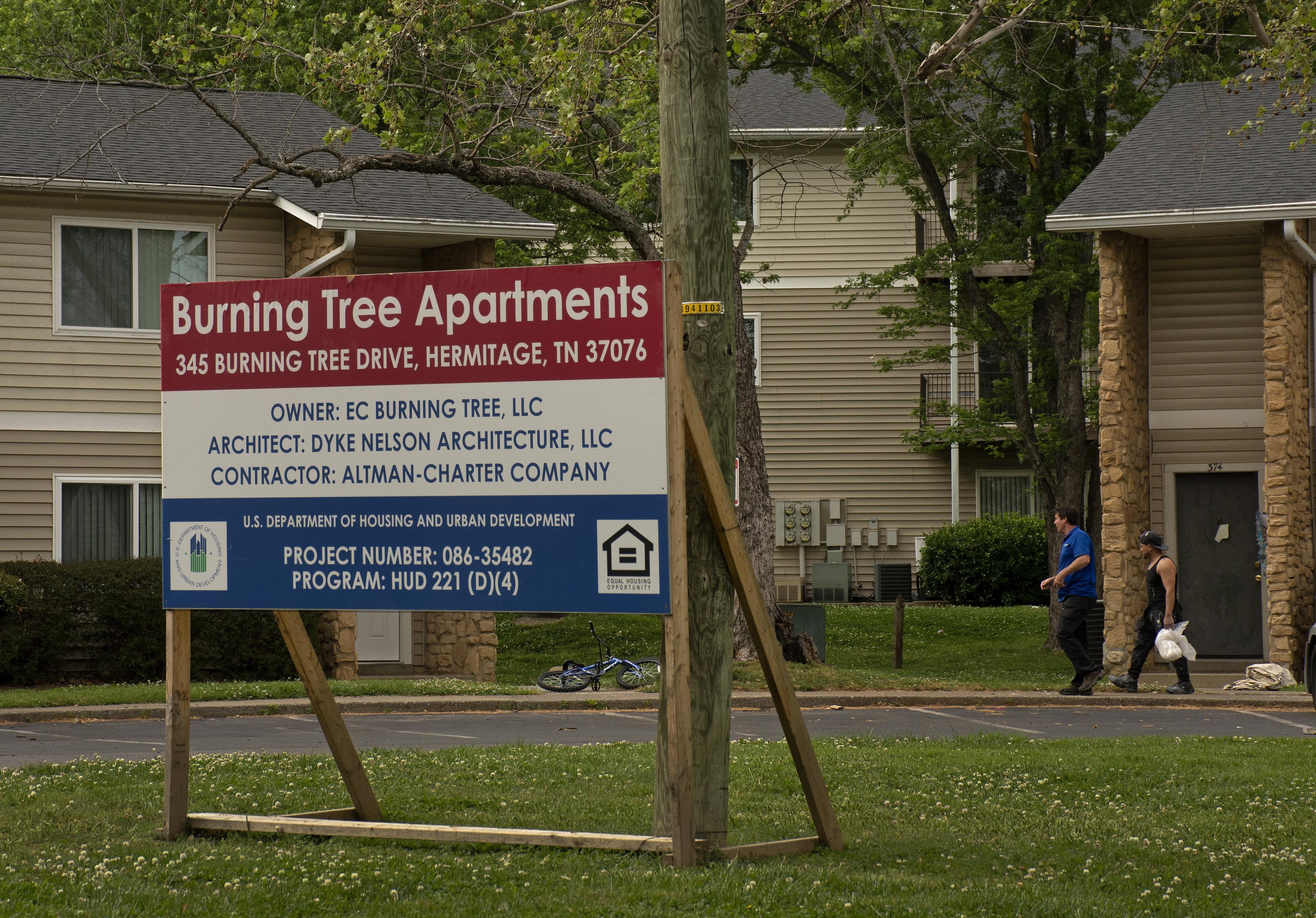
After months at the motel, residents were transitioned to apartments—but not together. Greg was sent to Burning Tree in Hermitage. Carrie was placed at Hillside Flats in Nashville, a part of the county that she had explicitly told her caseworker she did not want to be in. Without a phone, without an ID, and 45 minutes by foot from anyone she knew, she lasted a week before the placement collapsed.
Their housing lasted three to six months. At Burning Tree, Greg told me that every formerly homeless resident received an eviction notice on the same day—after renovations began on the property. Residents say that they felt that the funding from their vouchers may have been used to fund the renovations.
Davidson County court records show more than 60 detainer warrants filed against Burning Tree residents since March 2025—triple the property’s historical annual average. Every filing was handled by Nathan Chesley Lybarger, one of three attorneys that my eviction tracker identified as dominating Davidson County’s eviction pipeline. Three new cases were filed the week that this article was published.
Asked whether OHS or any organization working under contract placed people at Burning Tree, OHS said that people were housed there by “a local nonprofit using one of more than 390 locations within the low-barrier housing collective,” and that because those placements were made by a nonprofit rather than OHS directly, the office relies on those agencies for housing status updates.
Residents say that they were told that their rent assistance would continue for a year. For Greg M., it lasted six to seven months. He says that he did not know, during any of that time, that the Metropolitan Development and Housing Agency (MDHA), the agency administering his voucher, had taken over his housing complex.
What ended his tenancy was not a voucher lapse: he was evicted over an unexplained $500 fee before his annual recertification process even began. The recertification notice arrived in the mail after he was already evicted. Court records show a detainer warrant filed on 6 October 2025, 11 days later a judgment of $2,195.33, and active wage garnishment as of January 2026. Two other residents named by sources as coming from the same Hermitage encampment appear in the same records.
As of March 2025, Burning Tree was owned by MDHA—the same agency that administers Nashville’s Section 8 vouchers—after EC Burning Tree LLC quitclaimed the 22-acre property in a transaction prepared by Butler Snow LLP with no affordability covenants attached. The people placed there using vouchers, subsequently evicted and now garnished, were living in a property owned by the agency that controls whether they can ever receive a voucher again.
National best practice for permanent housing placements calls for home-based case management after move-in, with active retention services designed to catch landlord disputes, and to review certification failures and financial issues before they become eviction filings. Colorado’s state housing guidance sets a benchmark caseload of one case manager per 15 households.
Residents interviewed for this story described no such follow-up. Carrie, pregnant in her apartment, said that no one checked on her. The retention rates OHS cited in defense of its program describe interventions that deliver a service that Nashville’s residents say they never received.
Public records requests show more than $350,000 in rent payments from OHS to private landlords with no Metro contracts on file. OHS said that these payments were authorized as “Bridge Funding” under a funding resolution, using Metro’s approved vendor payment process, but did not identify the resolution or explain the vendor approval standard. In an email to me last year about the placements, Director April Calvin described the program as “not to be published.”
A vendor ledger obtained through public records requests shows Burning Tree’s property manager, Freeman-Webb Company, Realtors, as an active OHS rehousing vendor. The ledger also shows that Greenview Studios LLC received $53,299 in rehousing payments with no contract—exceeding the $50,000 threshold above which Metro procurement regulations require Division of Purchases approval.
Seven months after the Hermitage closure, eight families were taken from the Nashville Rescue Mission under nearly identical circumstances—at least $100,000 in COVID-era ARPA funds used to handpick families outside the coordinated entry process that OHS publicly holds up as its standard practice.
Text messages obtained through public records requests show Director Calvin selecting families by texting confidential case files over unencrypted messages, replying with notes such as “Please remove this family from the list.” One message read: “The units selected are zero bedrooms/studios with two beds. The landlords will need names in advance so lease agreements can be generated over the weekend in preparation for Monday. Apologies for interrupting your weekend.”
Misty Hill was offered a full year of rent at The Avenue on Clarksville Pike at $1,400 a month, followed by a Section 8 voucher. A second family was placed at Hillside Crossing under the same verbal promise. For some families, the vouchers eventually came; for others, they lapsed without notice. In at least two cases, rent arrived late or not at all, prompting landlords to seek payment directly from tenants who were unable to pay on their own.
The situation came to light through research, which I brought to the Nashville Scene. I am a signed witness on the Title VI complaint subsequently filed by two of these families.
Metro’s copies of the leases confirmed that despite OHS coordinating the placements, Metro appeared nowhere on them. The families say that they were never given copies—something that their case manager from Step Up on Second Street, who resigned in protest, asserts may have been deliberate. A signed lease would have categorized them as “permanently housed” and made them ineligible for the vouchers that they were promised.
The same structure appeared at Wallace Studios, a 131-unit affordable housing complex at 97 Wallace Road that opened in 2024. OHS paid over $90,000 to the facility in landlord engagement funds—Metro appearing nowhere on the leases, no documented commitment for ongoing rent support. When payments stopped, the debt became the tenants’.
Court records show one woman hit with a judgment of $14,140 after Wallace Studios filed for eviction in March 2025, according to court documents. And in another OHS placement a judgment of $17,620 the following October, according to court documents. Both people were confirmed as placed there by OHS. The complex filed 33 eviction suits in its first year of operation.
One of the women that filed the Title VI complaint says that after months of trying to get Metro to deliver on the housing voucher she had been promised, she reached someone in the Mayor’s Office by phone. According to her, she was told that since she was now housed, there was no need for a voucher. She says that person was Mayor Freddie O’Connell.
The Mayor’s Office confirms someone from their office spoke with her, but denies that it was O’Connell. Metro Legal advised against discussing constituent interactions publicly.
Carrie was pregnant in her apartment. She says that no counselor or outreach worker checked on her. When her housing collapsed, she and Greg ended up back in a tent. She told me that she gave the baby up for adoption.
She didn’t have to. At one point, she had a lease. She had a roof. For a brief window, she had the one thing that might have made it possible to keep her child.
They survived the ice storm in that thin tent. When I asked how it was for them, they exchanged a look that contained an ocean between them.
“It was rough,” Greg finally said.
*Names changed for privacy.