Street medicine: Naga, where care begins with listening
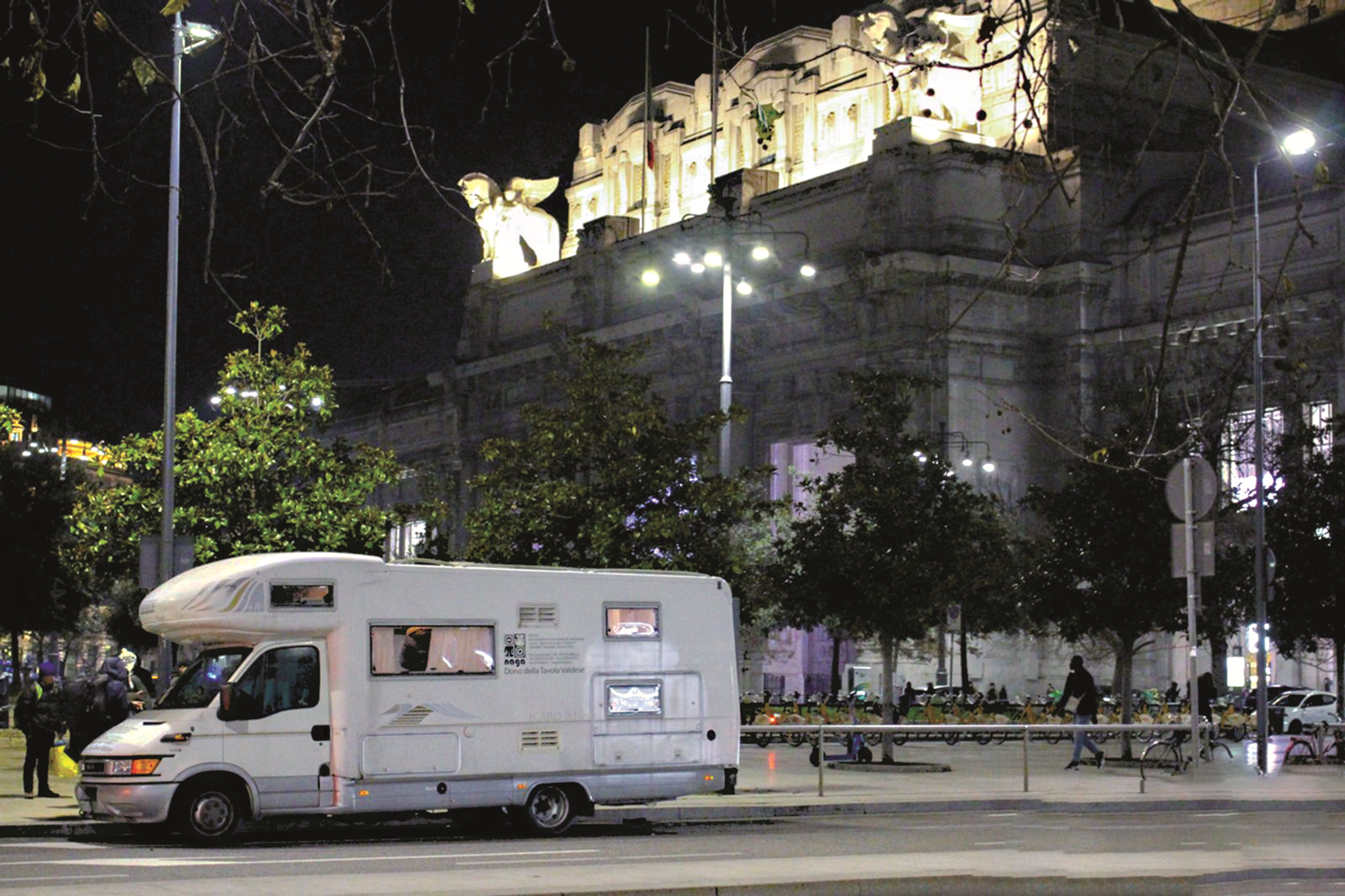

Photo courtesy of Naga
By Giulia Ghirardi
Translated from Italian via Translators Without Borders
- Lived experience

The Naga service currently provides medical assistance outside Milan’s Central Station and in Lambrate. The service is not only aimed at young people from outside of Italy, but also at an increasingly fragile segment of the Italian population: people who live on the margins and are unable to access national healthcare.
Wounds can be disinfected and bandaged in a few minutes. But many people’s lives are affected by loneliness, violence, and living a life in limbo on the city’s margins. Naga’s medical outreach service operates in this fine line, with the service bringing healthcare directly to marginalised places in Milan, where the right to healthcare all too often ceases to be a right.
Maura is one of the project’s volunteer doctors; she currently divides her time between the clinic and the camper van that she uses to reach people living on the streets. She talks about the history of a service that, over the years, has evolved in step with the city’s changes. “Medical outreach was created to help those who needed it,” she says. “However, those settlements have been dismantled and the families have dispersed. We continue to support many people on an individual basis, but we no longer work with the community in the same way we did at the start.”
In the meantime, Milan has changed, and the forms of exclusion have changed too. The Naga protest group has moved towards Central Station, which has become the main location for the camper van’s support in recent years. This where people arrive in transit – migrants passing through the city during their migratory journey, but also men and women who find themselves stranded in Milan, trapped in an administrative and social limbo.
More recently, the service has also become active in other parts of the city, such as Lambrate, where a different and less visible reality has emerged. “We have found an increasingly vulnerable section of the Italian population: people who for various reasons live on the margins and are unable to access standard healthcare,” Maura continues. “The fight for the right to healthcare does not just concern foreign nationals.”
What Naga observes every week is new forms of urban poverty. “The clinic acts like a family doctor in that people return, building up a relationship over time. However, healthcare outreach is unpredictable. We arrive every evening knowing that people who have never seen us before might approach us.” In the last two years, they have seen a marked increase in the number of young people from North Africa. They are usually aged between 17 and 25 and often share similar experiences of hardship. “We are seeing an increasingly frequent use of psychotropic drugs.”
Diagnoses, however, tell only part of the story. Another part of the tale emerges while dressings are being changed, when the time dedicated to attending to a wound becomes an opportunity to talk. “These are young people who set off without any real plan. Rather than chasing something, they wanted to leave behind a life that was suffocating them. They have suffered violence and neglect, and once they arrive here, they find themselves in a community of vulnerable people from which it is difficult to break free, because it represents their only certainty.”
They often come to ask for a bandage or some painkillers. But the healthcare contact is only the first step. “They get something to eat, something to drink, and then they find a health problem that becomes an excuse to stop, to stay, to talk.”
The injuries that staff encounter most frequently are those caused by self-harm. These signs convey a pain that is difficult to put into words. “They use their injuries as a way of escaping from a life that no one could bear.” Within such stories, however, one element is repeated regularly: “They are always talking about their mothers. They are afraid of disappointing them, they miss them, or they are the reason for their escape. When that happens, it reminds you that, first and foremost, they are children. And that is why what they need may be more than a prescription. They need a comforting hug, and five minutes when someone really listens to them. That is when you realise that the right to healthcare, on its own, is not enough. They need somewhere to live, work, an alternative life.”
That is why Naga’s work goes far beyond medicine. “We are trying to fill the gaps left by legislation, and to guarantee immediate care for those excluded from it. The most important factor is our welcome. The system treats these people differently and then rejects them. We try to tell them that people exist who are willing to open a door to them,” Maura says.
Some meetings have left a lasting impression on her. One case involved a young man who frequently presented with deep self-harm wounds. One day, she asked him why he kept hurting himself. His mother had been hospitalised after serious complications during the birth of his little brother. He did not know whether she was alive or dead. “At that moment I understood that behind that wound lay another, infinitely greater wound,” she says.
This is another reason why, at the end of every shift, a sense of realisation remains. “We try to offer as much as we can to the people we meet. But, in the end, it is they who enrich us,” concluded Maura. “It changes the way you look at the world as well as the way you approach life.”
She once met a young couple who had been married for a short time. They had crossed the Mediterranean from Algeria, imagining that, once they arrived in Europe, the worst would be behind them. They were due to reach relatives in Geneva. Milan was only meant to be a one-night stopover before catching the morning train. However, when they arrived at the street medical centre in Naga, their journey had already taken a different turn.
The young woman was covered in painful burns caused by the mixture of fuel and seawater that had remained at the bottom of the boat during their crossing. While the volunteers were treating the burns, another problem arose: the couple had nowhere to sleep. Without documents, nowhere was willing to accept them. The night that should have been the first night of their future together was in danger of ending on the floor of Central Station.
“It was terrible to see their dream shatter like that,” recalls Maura. “I don’t know what they had imagined before leaving, but it definitely was not this.” At that point, a friend who had learnt of their situation put them up in his home. The next morning, the young man’s father accompanied them to the station to catch the train to Geneva. “The gesture of two strangers reminded us that hospitality can come from a person’s initiative,” Maura says. And, above all, that the difference between a hostile city and a humane one lies in the choice not to leave a young married couple to sleep on the ground on the very day that their new life together was due to begin.